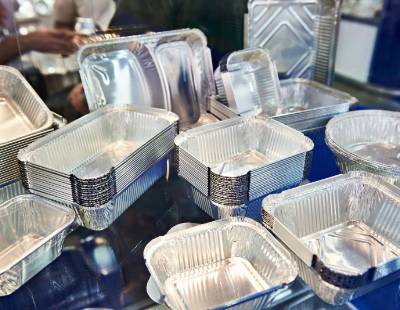
Order too small and customers complain about portions looking thin. Order too large and you pay for space that food does not fill.
Most buyers guess from photos. A few minutes with a scale and a measuring cup removes the guesswork.
Take your three best-selling dishes and weigh them. Not the recipe weight, the served weight including sauce.
Write down the gram weight for each. A typical single-serve main runs 350 to 500 grams. A family portion runs 800 to 1,200 grams. A sauce or side runs 30 to 80 grams.
Food density varies, but a rough guide works for most dishes. Rice and pasta sit around 0.7 grams per milliliter. Curries and stews with sauce sit around 0.9 to 1.0. Fried items sit around 0.4 to 0.5.
Divide the gram weight by the density to get approximate milliliters. A 400-gram curry at 0.95 density is about 420 milliliters.
Containers should not be filled to the rim. Leave 10 to 15 percent headspace so lids seal and food does not spill.
A 420-milliliter portion needs a container of roughly 480 to 500 milliliters. That lands between a 500-milliliter small and a 750-milliliter medium.
Numbers help, but a physical test settles it. Put your actual portion into a sample container and look at the fill line. If the food reaches the rim, go one size up. If the container looks half empty, go one size down.
Our sample packs include multiple sizes so you can test the real portion, not a guess.
Once the size is confirmed, multiply the number of servings per dish by the number of times that dish sells per month.
If a dish sells 300 times per month and the portion fits the 750-milliliter medium, you need 300 medium containers per month plus a buffer. Do this for each dish, then group by container size.
Choosing by the photo rather than the weight. Forgetting that sauce adds volume. Filling to the rim and forcing the lid. Using one size for both a light salad and a dense curry.
Each mistake is fixable once the portion is measured.
We send sample packs with multiple sizes so you can test actual portions. We share fill-line guidance and recommend sizes based on your dish list and monthly sales.
Send us your three best-selling dishes with their served weights and monthly sales, and we will suggest a size and order rhythm.